How Long Until 12:05? A Simple Guide to Counting Down the Minutes
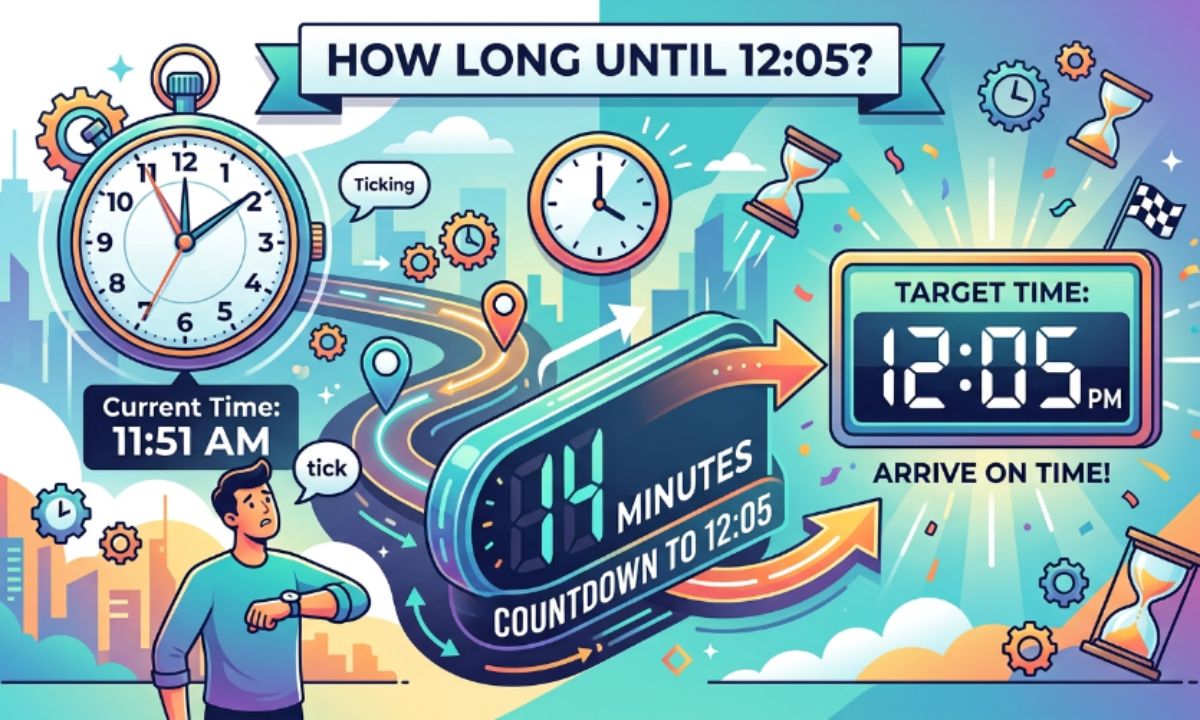
Ever look at the clock and wonder exactly how long until 12:05? Whether you are counting down to a lunch break, a midnight celebration, or an important meeting, tracking the remaining minutes is simple once you know the right tricks.
This quick guide will show you how to calculate the exact time left before the clock strikes 12:05. You will learn easy mental math shortcuts to count down hours and minutes without any stress.
Quick Answer
The time left until 12:05 depends entirely on what time it is right now. There’s no fixed answer — it changes every second. But the calculation itself is dead simple:
Subtract the current time from 12:05. If the current time is earlier than 12:05 on the same clock cycle (AM or PM), just subtract normally. If it’s already past 12:05, you’re counting toward the next occurrence of 12:05, which could be 12 hours or even a full day away, depending on whether you mean 12:05 AM or 12:05 PM.
For example, if it’s currently 11:47 AM, the time until 12:05 PM is 18 minutes. If it’s currently 12:20 PM, the next 12:05 is tomorrow at 12:05 AM (or PM), which is a much longer wait.
Why “12:05” Is a Little Confusing to Begin With
Here’s the thing nobody says out loud: 12:05 is ambiguous by itself. Is it 12:05 in the morning, right after midnight? Or 12:05 in the afternoon, just past noon? Both are valid readings, and both trip people up for different reasons.
Noon and midnight are the two spots on a 12-hour clock where the numbering resets, and that reset is where confusion creeps in. People often assume “12:05” automatically means daytime, but plenty of countdowns — flight departures, medication schedules, server maintenance windows — happen at 12:05 AM instead.
So before you calculate anything, pin down which 12:05 you’re actually counting toward. Everything below works the same way for either one; you just need to know your starting point.
How to Calculate the Time Until 12:05
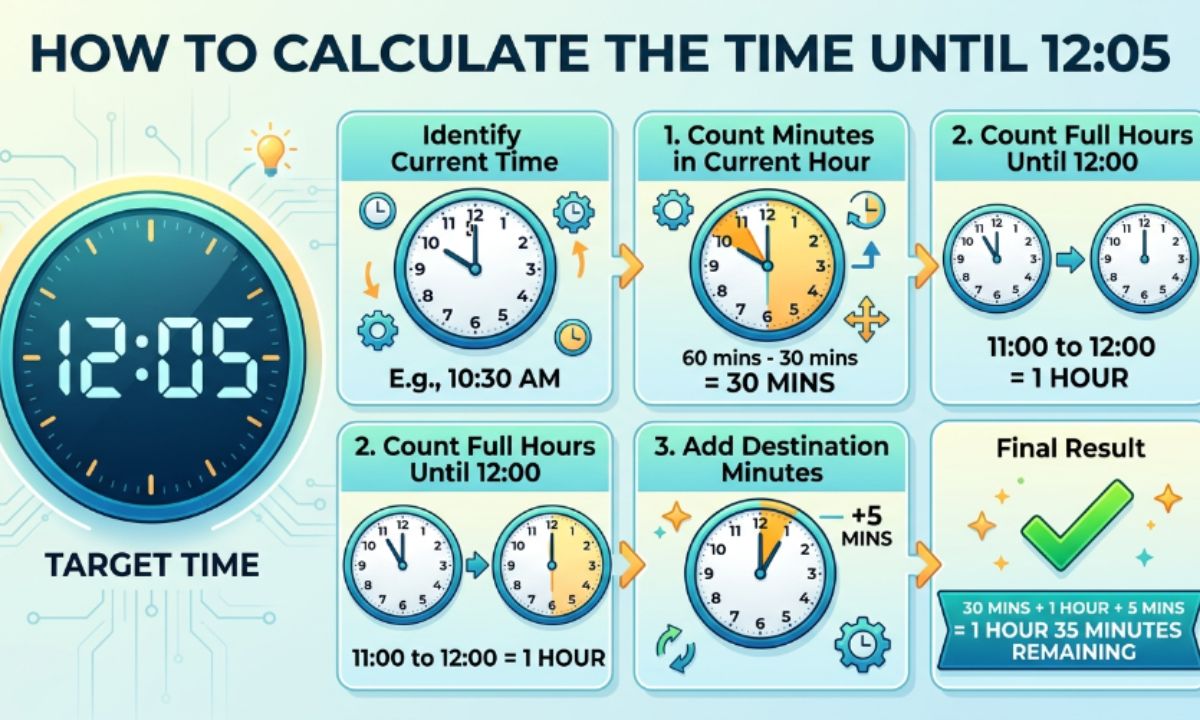
You don’t need an app for this. Here’s the method, broken into steps you can do in your head or on paper.
Step 1: Note your current time
Look at a clock, your phone, or your computer. Write down the current hour and minute. Let’s use an example: it’s currently 10:42 AM, and you want to know how long until 12:05 PM.
Step 2: Convert both times to minutes past midnight
This removes the “hour and minute” confusion and turns it into one simple number.
- 10:42 AM = (10 × 60) + 42 = 642 minutes
- 12:05 PM = (12 × 60) + 5 = 725 minutes
Step 3: Subtract
725 − 642 = 83 minutes
That’s your answer. 83 minutes converts to 1 hour and 23 minutes.
Step 4: Convert back to hours and minutes (optional but helpful)
Divide by 60 to get whole hours, then keep the remainder as minutes.
- 83 ÷ 60 = 1 hour, remainder 23 minutes
- So: 1 hour and 23 minutes until 12:05 PM
Step 5: Adjust if the target time has already passed
If your current time is later than 12:05 (say it’s 3:00 PM and you’re asking about 12:05 PM), you’re not counting minutes anymore — you’re counting toward tomorrow. Add 24 hours (1,440 minutes) to the target time before subtracting.
Worked Examples: Common Starting Times
Here’s a table showing how long you’d have to wait until 12:05 PM from a handful of common starting points. Use it as a quick reference, or as a model for calculating your own.
| Current Time | Time Until 12:05 PM |
| 9:00 AM | 3 hours 5 minutes |
| 10:15 AM | 1 hour 50 minutes |
| 11:00 AM | 1 hour 5 minutes |
| 11:45 AM | 20 minutes |
| 11:59 AM | 6 minutes |
| 12:00 PM (noon) | 5 minutes |
| 12:05 PM | 0 minutes (it’s now) |
| 12:10 PM | 23 hours 55 minutes (next day) |
And here’s the same idea, but counting toward 12:05 AM instead — useful if you’re tracking a midnight deadline or an early-morning event.
| Current Time | Time Until 12:05 AM |
| 8:00 PM | 4 hours 5 minutes |
| 9:30 PM | 2 hours 35 minutes |
| 11:00 PM | 1 hour 5 minutes |
| 11:50 PM | 15 minutes |
| 12:00 AM (midnight) | 5 minutes |
| 12:05 AM | 0 minutes (it’s now) |
| 12:30 AM | 23 hours 35 minutes (next day) |
Converting the Answer Into Different Units
Sometimes minutes alone don’t tell the full story, especially if the wait is long. Here’s how to break the same time gap into different formats.
| Format | Example (83 minutes) |
| Minutes | 83 minutes |
| Hours + minutes | 1 hour, 23 minutes |
| Decimal hours | 1.38 hours |
| Seconds | 4,980 seconds |
To get decimal hours, divide the total minutes by 60. So 83 ÷ 60 = 1.383, rounded to 1.38. This format is handy for timesheets, billing, or anything that needs a clean decimal rather than a clock-style split.
Real-World Scenarios Where This Question Comes Up
This isn’t just an abstract math exercise — people search “how long until 12:05” for pretty specific, practical reasons:
- Catching a bus or train that departs at 12:05 and figuring out if there’s time to grab coffee first.
- Timing a phone call or meeting scheduled for 12:05, especially across time zones where the math gets messy fast.
- Medication schedules where a dose is due at 12:05 AM or PM and someone needs a precise countdown.
- Cooking or baking, where a timer needs to finish at exactly 12:05 so food comes out at the right moment.
- Live events or streams that go live at 12:05, and viewers want a countdown rather than doing the subtraction themselves.
- Work shifts or breaks that start or end at 12:05, particularly around the lunch hour when noon-based scheduling is common.
Notice a pattern? Almost all of these involve a deadline that’s close to now — within the same hour or two. That’s exactly why the quick mental-math method above works so well: most people aren’t calculating a countdown that’s 20 hours away, they’re calculating one that’s 20 minutes away.
Common Mistakes People Make With This Kind of Calculation
A few errors show up again and again when people try to do this math on the fly:
- Forgetting AM vs. PM. Mixing up 12:05 AM and 12:05 PM is the single most common mistake, especially since both get shortened to “12:05” in casual conversation.
- Treating the clock like base-10. Clocks run on a 60-minute base, not 100. Subtracting 10:42 from 12:05 like a decimal (12.05 − 10.42) gives a wrong and confusing result. Always convert to total minutes first, as shown in Step 2 above.
- Ignoring the date rollover. If the target time has already passed for the day, the countdown isn’t negative — it wraps around to the next day. Skipping this step gives a nonsensical negative number.
- Confusing noon and midnight labeling. Some digital systems label midnight as 00:00 and others as 12:00 AM, which can throw off manual calculations if you’re not consistent.
- Rounding too early. If you round minutes to the nearest five before finishing the calculation, small errors stack up. Do the full subtraction first, round at the end if you need to.
Why People Search for This Specific Time
Noon-adjacent times like 12:05 get searched a lot more than random times like, say, 2:47. There’s a reason: 12:05 usually marks the tail end of a scheduled event that starts right at noon, or it’s the trigger point right after a lunch break, meeting, or broadcast begins. It’s close enough to a “round” number (noon) that people expect it to be easy to calculate, and then get thrown off by the AM/PM ambiguity or the minute-based math.
There’s also a simpler explanation: a lot of recurring daily tasks — reminders, alarms, cron jobs, livestream start times — get set for “five minutes past” a major hour marker like noon or midnight, since it gives a small buffer after everyone expects things to start “on the hour.”
Related Calculations You Might Also Need
If this kind of question is useful to you, these related calculations follow the exact same method:
- How long until 12:00 (noon or midnight)
- How long until 1:00 PM
- Time between two arbitrary clock times (not tied to now)
- Converting a countdown into a percentage of the day remaining
- Calculating elapsed time since a past event, rather than time until a future one
The underlying trick is always the same: convert both times into minutes since midnight, subtract, then convert the result back into a readable hours-and-minutes format.
Conclusion
There’s no single fixed answer to “how long until 12:05” because it depends on the moment you’re asking. But the method to find out takes about ten seconds once you know it: note the current time, convert both times to minutes past midnight, subtract, and convert back.
Keep an eye on AM versus PM, and remember that if 12:05 has already passed today, you’re counting toward tomorrow’s version of it instead. Once you’ve done this calculation a couple of times, it becomes second nature — no calculator or app required.
Frequently Asked Questions
How do I quickly calculate how long until 12:05 without doing math?
Check your phone or computer’s clock app — most let you set a countdown timer or alarm for a specific time, which does the subtraction for you automatically.
Is 12:05 closer to noon or midnight?
12:05 itself refers to five minutes past either noon or midnight, depending on whether it’s labeled AM (midnight) or PM (noon). Neither is “closer” — they’re two separate points on the clock, twelve hours apart.
What if it’s already past 12:05 today — how do I count the time until the next one?
Add 24 hours to 12:05 (turning it into a time on the following day), then subtract the current time from that total, following the same minutes-based method described above.
Why do digital countdowns sometimes show a different answer than my manual calculation?
Digital countdowns usually run in real time down to the second, while manual calculations often round to the nearest minute. A small mismatch of a few seconds is normal and not an error.
Does the time until 12:05 change with time zones?
Yes. “12:05” only makes sense within a specific time zone. If you’re coordinating across zones, convert everyone’s local time to a single reference zone (like UTC) before calculating the gap.

Shoaib is a passionate digital creator, blogger, and SEO enthusiast who shares insights about AI tools, blogging, online earning, content strategies, and website growth. Through practical guides and creative ideas, Shoaib helps beginners and creators build successful online platforms and stay updated with the latest digital trends.