
How Many Days Until the First Day of Summer? (Exact Countdown)
Wondering how many days are left until the first day of summer? This guide gives you a simple countdown and explains when summer officially begins. You can quickly check the exact number of days left.
The first day of summer depends on whether you mean astronomical summer or meteorological summer. Keep reading to find the date, countdown, and an easy way to calculate the days yourself.
Quick Answer
As of September 22, 2026, there are 272 days until the first day of summer, which falls on Monday, June 21, 2027. This is the astronomical start of summer in the Northern Hemisphere, marked by the June solstice, the exact moment the sun reaches its highest point in the sky for the year.
That countdown shrinks by one day every single day, so if you are reading this later, subtract accordingly. The table below gives you a faster way to check.
Why the Date Isn’t Always June 21st
Most people assume summer always starts on June 21st. It doesn’t. The astronomical start of summer, known as the summer solstice, lands on either June 20th or June 21st depending on the year. Some years it even drifts to June 22nd, though that is rare in the current century.
Here is the reason. A calendar year has 365 days, but Earth actually takes about 365.242199 days to complete one orbit around the sun. That leftover chunk of a day builds up over four years, which is why we add a leap day in February. Leap years nudge the solstice date earlier, and the three years after a leap year slowly push it back later again.
That is why the solstice date wobbles instead of staying fixed.
Summer Solstice Dates by Year
| Year | Date | Day of Week |
| 2025 | June 20 | Friday |
| 2026 | June 21 | Sunday |
| 2027 | June 21 | Monday |
| 2028 | June 20 | Tuesday |
| 2029 | June 20 | Wednesday |
| 2030 | June 21 | Friday |
Notice how 2028, a leap year, pulls the date back to June 20th. That pattern repeats roughly every four years, though it is not perfectly mechanical because of how leap years are distributed across centuries.
Astronomical Summer vs Meteorological Summer
This is the part that trips up almost everyone searching for this topic, and it is worth slowing down on.
Astronomical summer is tied to Earth’s position relative to the sun. It begins at the June solstice and ends at the September equinox. Because solstice and equinox dates shift slightly year to year, astronomical summer does not start on a fixed calendar date.
Meteorological summer is a fixed system that climatologists and weather agencies use for record-keeping. It always runs from June 1st to August 31st, split cleanly into three full calendar months. This makes comparing historical weather data much simpler than working around a wobbling solstice date.
| Summer Type | Start Date | End Date | Basis |
| Astronomical Summer | Around June 20-21 | Around September 22-23 | Earth’s tilt and orbit |
| Meteorological Summer | June 1 (fixed) | August 31 (fixed) | Calendar months, used for weather data |
If someone tells you summer “already started” in early June, they are using the meteorological definition. If your countdown app says summer starts on the solstice, it is using the astronomical one. Neither is wrong, they are just answering different questions.
How to Calculate Days Until the First Day of Summer Yourself
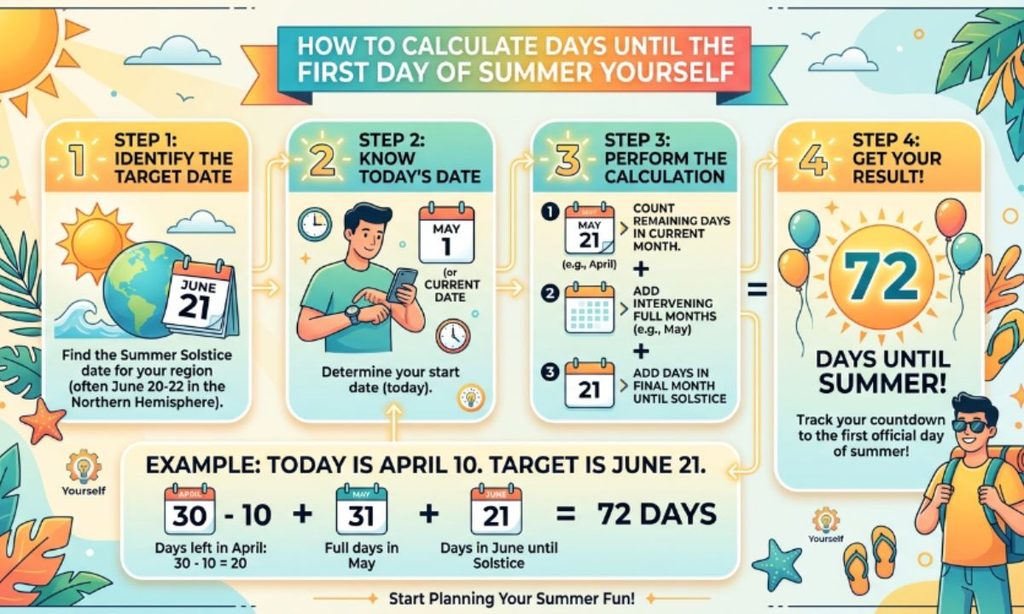
You do not need any special tool for this. Here is the step-by-step approach.
Step 1: Confirm This Year’s Solstice Date
Look up the exact solstice date and time for the upcoming year. The date itself is easy to find, but the exact time (given in UTC) matters if you want precision down to the hour, since the solstice is a specific moment, not an all-day event.
Step 2: Count the Days From Today to That Date
Add up the remaining days in the current month, then the full days in every month in between, then the days into the target month up to the solstice date itself.
Step 3: Adjust for Leap Years
If February falls between today and the solstice date and it happens to be a leap year, remember that month has 29 days instead of 28. This single extra day can throw off a manual count if you forget it.
Step 4: Double-Check With a Reverse Calculation
A good sanity check is counting backward from the solstice to today. If both numbers match, your count is accurate.
Worked Example: Counting From September 22, 2026
Here is the full breakdown used to reach the 272-day figure above.
| Period | Days |
| Remaining in September 2026 | 8 |
| October 2026 | 31 |
| November 2026 | 30 |
| December 2026 | 31 |
| January 2027 | 31 |
| February 2027 | 28 |
| March 2027 | 31 |
| April 2027 | 30 |
| May 2027 | 31 |
| June 1-21, 2027 | 21 |
| Total | 272 days |
Notice February 2027 gets 28 days, not 29, because 2027 is not a leap year. That is exactly the kind of detail that trips up a manual calculation if you rush it.
Common Mistakes People Make With This Calculation
Confusing the solstice with June 1st. These are two different definitions of summer, and mixing them up produces a wildly wrong countdown, sometimes off by nearly three weeks.
Forgetting leap year adjustments. Skipping the leap day, or adding one where it doesn’t belong, throws the whole count off by a full day.
Assuming the date never changes. Because June 21st appears so often, people bake it in as a fixed fact. It shifts based on the leap year cycle, and treating it as permanent leads to small errors that compound over multi-year calculations.
Ignoring time zones for the exact moment. The solstice happens at one specific instant worldwide, but that instant lands on different calendar dates depending on your time zone. Someone in Tokyo might already be in the next calendar day when someone in New York is still counting down hours.
Why People Search for This So Often
This search spikes every year for a mix of practical and emotional reasons.
People planning vacations want a fixed target for booking flights or renting cabins before summer travel prices climb. Parents track it because it usually lines up close to the end of the school year, even though the two dates rarely match exactly. Event planners use the solstice as a marketing hook for sales, festivals, and seasonal promotions. And a decent chunk of searches come from people who simply feel done with a long winter and want a concrete number to count down.
There is also a cultural layer here. The summer solstice carries meaning in various traditions around the world, from Midsummer celebrations in Scandinavia to gatherings at ancient sites built to align with the sun’s position on this exact day. That historical weight adds curiosity beyond the purely practical angle.
Related Time Calculations Worth Knowing
If this kind of countdown is useful to you, a few related calculations follow the same logic.
Days until the first day of fall uses the September equinox instead of the June solstice, and it wobbles for the same leap-year reasons.
Days until the winter solstice marks the shortest day of the year and the astronomical start of winter, usually landing around December 21st.
Days until the spring equinox marks when day and night are nearly equal in length, typically falling around March 20th.
Meteorological season countdowns are far simpler to calculate since they always fall on the 1st of a fixed month, with no solstice math required.
Each of these follows the same core skill: know your target date, count the days between, and adjust for leap years when February sits in the middle of your range.
Conclusion
The first day of summer, astronomically speaking, is Monday, June 21, 2027, which puts us at 272 days out as of September 22, 2026. The date moves slightly year to year because of how leap years correct the mismatch between our 365-day calendar and Earth’s actual orbit.
Once you understand that mechanic, calculating this countdown for any future year becomes a simple, repeatable process rather than a guessing game.
Frequently Asked Questions
How many days until the first day of summer 2027?
As of September 22, 2026, there are 272 days until the first day of summer, which lands on Monday, June 21, 2027.
Is the first day of summer always June 21st?
No. It shifts between June 20th and June 21st depending on the year, largely due to the leap year cycle affecting the exact timing of the solstice.
What is the difference between astronomical and meteorological summer?
Astronomical summer starts at the June solstice and ends at the September equinox, while meteorological summer always runs from June 1st through August 31st for consistent weather record-keeping.
Why does the summer solstice date change every year?
Earth’s orbit takes slightly longer than 365 days, so the extra time accumulates and shifts the solstice date earlier or later until a leap year resets the balance.
Does the first day of summer happen at the same time everywhere in the world?
No. The solstice is one specific global moment, but local time zones mean it can land on different calendar dates depending on where you are, and it marks the start of winter rather than summer in the Southern Hemisphere.

Shoaib is a passionate digital creator, blogger, and SEO enthusiast who shares insights about AI tools, blogging, online earning, content strategies, and website growth. Through practical guides and creative ideas, Shoaib helps beginners and creators build successful online platforms and stay updated with the latest digital trends.
One Comment