
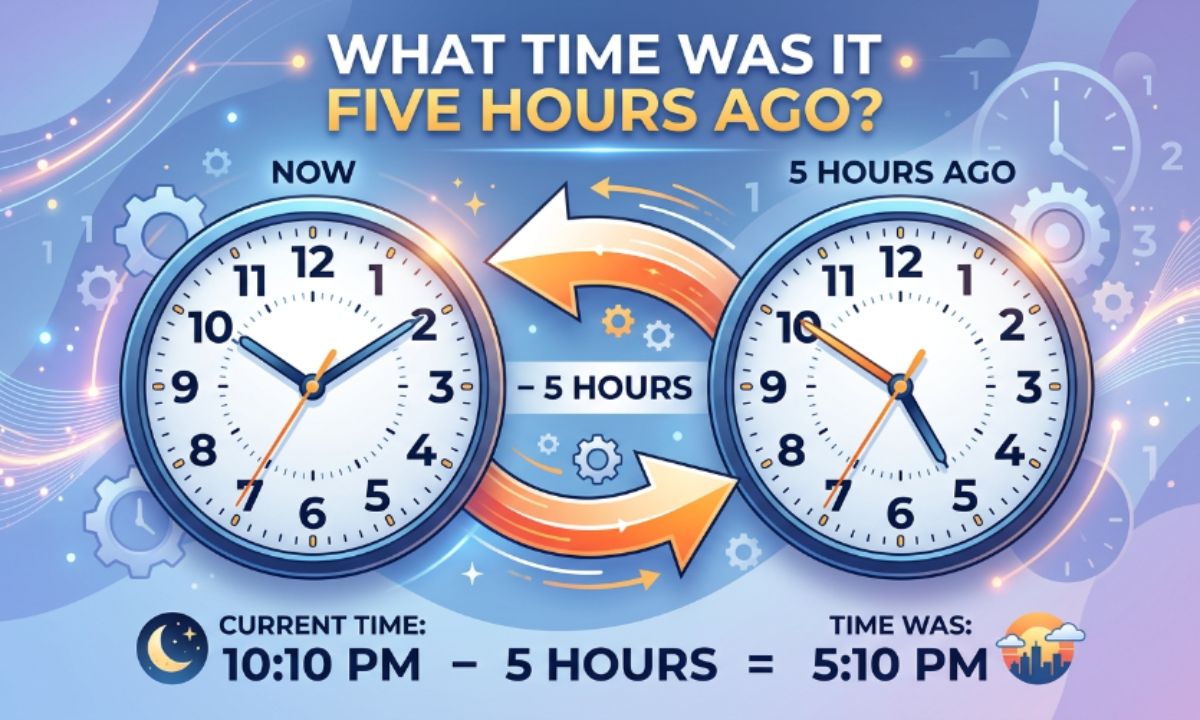
What Time Was It Five Hours Ago? Quick Answer and Full Breakdown
Ever caught yourself trying to work backward from the current time and losing track halfway through? It happens more than people admit. Maybe you’re checking when a phone call actually came in, figuring out when a delivery driver left the warehouse, or just settling an argument about when someone left the house.
Whatever the reason, subtracting hours from the clock trips people up more than it should.This article breaks down exactly how to calculate what time it was five hours ago, shows you the method with real examples, and clears up the mistakes that trip people up when the subtraction crosses midnight or flips between AM and PM.
Quick Answer: What Time Was It Five Hours Ago
To find out what time it was five hours ago, take the current time and subtract 5 from the hour value. If the current hour is less than 5, you borrow 12 hours and switch between AM and PM (or roll back to the previous day).
Here’s the simplest version of the rule:
Current Time minus 5 hours = Time Five Hours Ago
For example, if it’s 3:00 PM right now, five hours ago it was 10:00 AM. If it’s 2:00 AM right now, five hours ago it was 9:00 PM the previous day. That second example is where most people mess up, so keep reading for the full method.
The Simple Formula for Subtracting Five Hours
The math behind this is basic subtraction, but the AM/PM switch and the day rollover are what make it feel confusing. Here’s the formula broken into plain steps.
Step 1: Write down the current hour and minute. Step 2: Subtract 5 from the hour. Step 3: If the result is zero or negative, add 12 to get the correct hour and flip AM to PM or PM to AM. Step 4: If subtracting 5 hours pushes you past midnight, move the date back by one day.
Minutes stay exactly the same throughout this process since you’re only subtracting whole hours. Only the hour value and possibly the AM/PM label and the date will change.
Time Conversion Table: Five Hours Ago From Any Hour
Instead of doing the math every single time, here’s a full reference table showing five hours earlier for every hour on the clock.
| Current Time | Time Five Hours Ago |
| 12:00 AM | 7:00 PM (previous day) |
| 1:00 AM | 8:00 PM (previous day) |
| 2:00 AM | 9:00 PM (previous day) |
| 3:00 AM | 10:00 PM (previous day) |
| 4:00 AM | 11:00 PM (previous day) |
| 5:00 AM | 12:00 AM |
| 6:00 AM | 1:00 AM |
| 7:00 AM | 2:00 AM |
| 8:00 AM | 3:00 AM |
| 9:00 AM | 4:00 AM |
| 10:00 AM | 5:00 AM |
| 11:00 AM | 6:00 AM |
| 12:00 PM | 7:00 AM |
| 1:00 PM | 8:00 AM |
| 2:00 PM | 9:00 AM |
| 3:00 PM | 10:00 AM |
| 4:00 PM | 11:00 AM |
| 5:00 PM | 12:00 PM |
| 6:00 PM | 1:00 PM |
| 7:00 PM | 2:00 PM |
| 8:00 PM | 3:00 PM |
| 9:00 PM | 4:00 PM |
| 10:00 PM | 5:00 PM |
| 11:00 PM | 6:00 PM |
Keep this table bookmarked if you deal with time zone calls, shift schedules, or logs that record events in relative time.
How to Calculate Five Hours Ago Manually
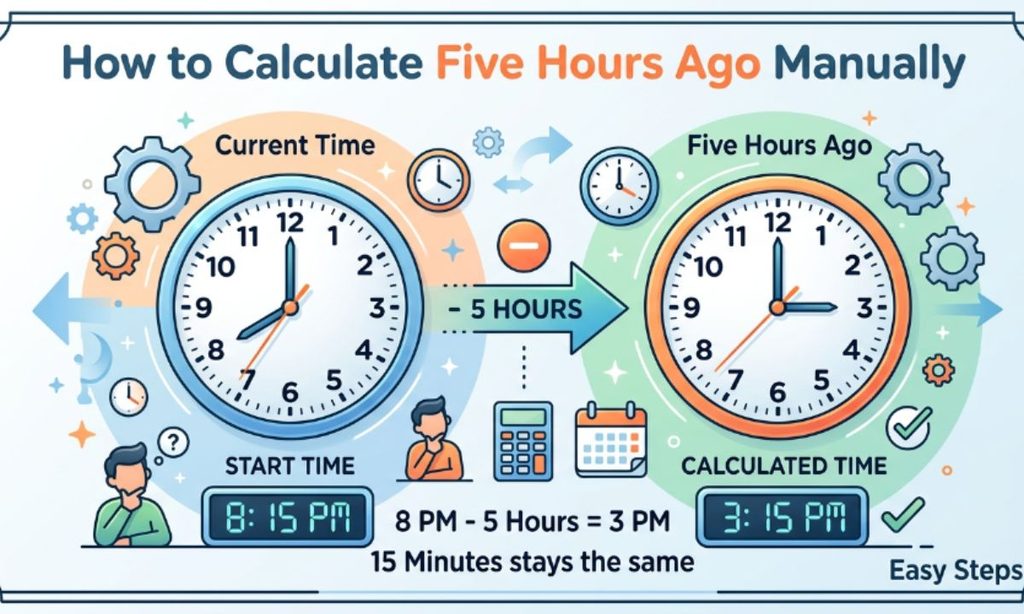
If you’d rather understand the logic instead of relying on a table, here’s the full manual process broken into digestible steps.
Step 1: Note the Exact Current Time
Start with the precise hour and minute right now, including whether it’s AM or PM. Precision matters here because even a small mistake at this stage throws off the entire calculation.
Step 2: Subtract 5 From the Hour Number
Take just the hour digit and subtract 5. Ignore AM/PM and minutes for this step. If the current hour is 9, you get 4. If the current hour is 2, you get negative 3, which means you’ll need the borrowing step below.
Step 3: Handle the Borrowing When the Hour Goes Below Zero
When subtracting 5 gives you zero or a negative number, add 12 to fix it. So if you calculated negative 3, add 12 to get 9. This also means you flip the AM/PM label: PM becomes AM, or AM becomes PM depending on direction.
Step 4: Check Whether the Date Rolls Back
If the current time is between 12:00 AM and 4:59 AM, subtracting five hours pushes you into the previous day. This is the step people forget most often, especially when they’re only thinking in terms of the clock face and not the calendar.
Step 5: Confirm Your Final Answer
Put the hour, minute, AM/PM label, and date (if it changed) together for your final answer. Double-check by counting forward 5 hours from your answer to see if you land back on the original time.
Real-World Examples of Calculating Five Hours Ago
Seeing the math applied to real situations makes the concept stick better than abstract rules alone.
Example 1: Daytime calculation. It’s currently 4:30 PM. Subtract 5 from the hour: 4 minus 5 equals negative 1, so add 12 to get 11, and flip PM to AM. The answer is 11:30 AM, same day.
Example 2: Crossing midnight. It’s currently 1:15 AM. Subtract 5: 1 minus 5 equals negative 4, add 12 to get 8, flip AM to PM. Since the original time was before 5:00 AM, the date rolls back. The answer is 8:15 PM the previous day.
Example 3: Clean subtraction, no borrowing. It’s currently 9:45 PM. Subtract 5: 9 minus 5 equals 4, no borrowing needed, stays PM. The answer is 4:45 PM, same day.
Example 4: Noon edge case. It’s currently 12:00 PM. Subtract 5: 12 minus 5 equals 7, still PM technically becomes AM here since noon minus any hours moves into the morning. The answer is 7:00 AM, same day.
Why People Search “What Time Was It Five Hours Ago”
This isn’t just idle curiosity. There are practical reasons people type this exact question into a search bar.
- Verifying phone or message timestamps: Someone wants to know when a call, text, or notification actually came in relative to right now.
- Coordinating across time zones: Remote workers and international teams often need to translate “five hours ago” into a specific clock time for a colleague elsewhere.
- Checking work shifts or attendance: Employers and employees sometimes need to confirm when a shift started based on how long ago it began.
- Settling a dispute or alibi: People occasionally need to establish what time something happened relative to the present moment, especially in casual disagreements.
- Tracking food, medication, or activity timing: Health-related tracking like “when did I last eat” or “when did I take my last dose” often gets phrased this way.
Common Mistakes When Calculating Hours Backward
Even simple subtraction goes wrong in predictable ways. Here are the mistakes that show up most often.
- Forgetting the date change: Subtracting hours late at night or early in the morning often pushes the result into the previous calendar day, and this step gets skipped constantly.
- Mixing up AM and PM: Because the 12-hour clock isn’t linear like 24-hour time, people frequently forget to flip the label when hours borrow across the noon or midnight mark.
- Confusing “five hours ago” with “in five hours”: These are opposite directions on the timeline, and it’s an easy slip when reading quickly.
- Ignoring minutes: Some people round the current time to the nearest hour before subtracting, which throws off precision when exact timestamps matter.
- Applying daylight saving shifts incorrectly: On the two days a year when clocks change, a straight five-hour subtraction can be off by an extra hour if the calculation crosses the shift.
Related Time Calculations Worth Knowing
Once you’ve got this concept down, a few related calculations tend to come up in the same context.
- What time was it three hours ago: Uses the same borrowing logic but with a smaller subtraction, so fewer situations trigger a date rollover.
- What time will it be in five hours: The mirror image of this calculation, adding instead of subtracting, useful for planning ahead rather than looking back.
- How many hours until a specific time: A forward-looking countdown calculation that uses addition and often comes up alongside backward time math.
- Time zone conversion between cities: Involves both an hour offset and sometimes a date change, similar to the borrowing step covered here.
- 24-hour to 12-hour time conversion: Understanding this makes the AM/PM flipping step in backward time math much more intuitive.
Conclusion
Figuring out what time it was five hours ago comes down to one simple habit: subtract 5 from the hour, and watch for two things, whether you need to borrow 12 hours and flip AM/PM, and whether the date rolls back to the previous day.
Once that borrowing logic clicks, the calculation takes seconds instead of minutes. Keep the reference table handy for a quick lookup, or run through the five-step method whenever you need to double-check your work by hand.
Frequently Asked Questions
What time was it five hours ago if it’s currently midnight?
If it’s currently 12:00 AM, five hours ago it was 7:00 PM the previous day.
Does subtracting five hours always change the date?
No, it only changes the date if the current time is between 12:00 AM and 4:59 AM.
How is subtracting five hours different from subtracting five minutes?
Subtracting hours moves the hour value and possibly flips AM/PM or the date, while subtracting minutes only affects the minute value and rarely crosses into a new hour label.
Can I use this same method for any number of hours, not just five?
Yes, the same borrowing and date-rollover logic applies whether you’re subtracting three hours, five hours, or twelve hours, just adjust the number you subtract from the hour.
What’s the fastest way to check this without doing math?
Use the reference table in this article, or set a countdown app that automatically calculates past and future times for you.

Shoaib is a passionate digital creator, blogger, and SEO enthusiast who shares insights about AI tools, blogging, online earning, content strategies, and website growth. Through practical guides and creative ideas, Shoaib helps beginners and creators build successful online platforms and stay updated with the latest digital trends.
2 Comments