
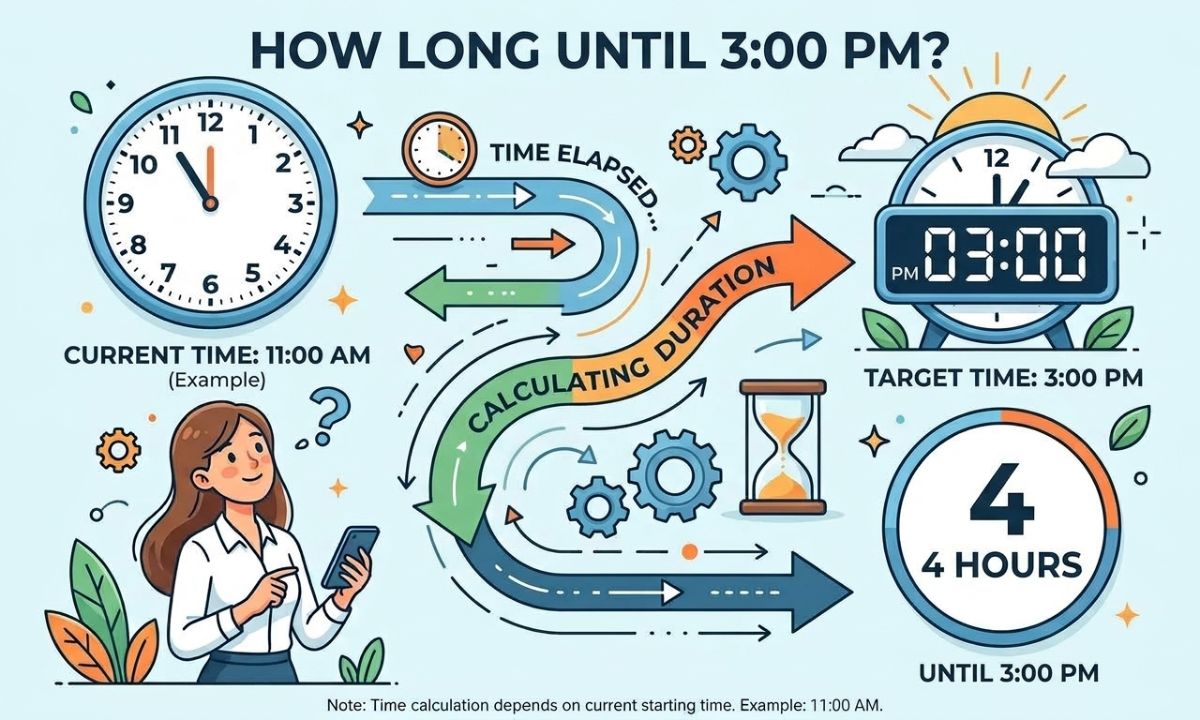
How Long Until 3 PM? The Simple Way to Calculate It Every Time
Wondering how long until 3 PM? You can find the answer quickly by checking the current time and counting the hours and minutes left.
This guide explains a simple way to calculate the time until 3 PM. It also shows easy examples for different times of the day.
Quick Answer: How to Find the Time Until 3 PM
The fastest way is this simple formula:
Time until 3 PM = 3:00 PM − Current Time
If you’re using a 24-hour clock, 3 PM is 15:00. So subtract your current time (in 24-hour format) from 15:00, and you’ve got your answer.
For example:
- If it’s 1:00 PM, you have 2 hours left.
- If it’s 11:45 AM, you have 3 hours and 15 minutes left.
- If it’s 2:50 PM, you’re 10 minutes away.
That’s it — that’s the whole trick. Everything else in this article is just showing you how to apply that formula cleanly no matter what time you’re starting from.
Why “3 PM” Trips People Up More Than Other Times
Most people don’t struggle with math here — they struggle with the clock format switch. Here’s the thing: 3 PM sits right in that awkward zone where you’re subtracting across the 12-hour mark, and if you’re not careful, you’ll either add an extra hour or lose one.
A few reasons this specific calculation causes confusion:
- People forget that 12 PM (noon) resets the hour count, so counting “12, 1, 2, 3” instead of treating noon as hour zero throws the math off.
- AM and PM get crossed when someone’s tired or rushing, especially with digital clocks that don’t always show the full label clearly.
- Time zone differences confuse remote workers who are calculating “3 PM their time” vs. “3 PM my time.”
- Mental math under pressure (like before a deadline) is just harder — anxiety makes simple subtraction feel complicated.
None of this means you’re bad at math. It just means the format itself invites small errors, and having a clear method removes the guesswork.
How to Calculate Time Until 3 PM
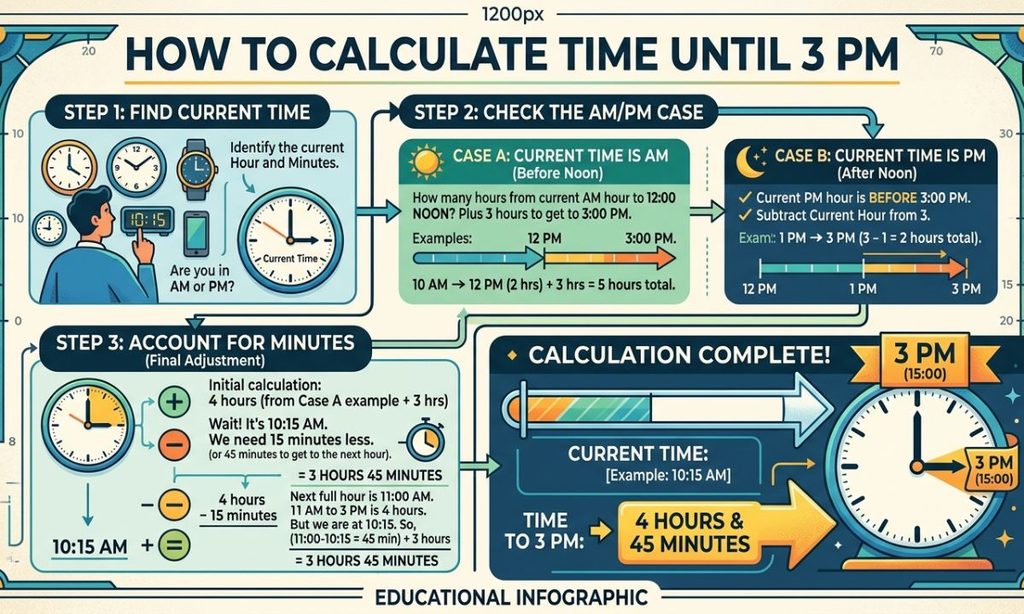
Here’s a method that works regardless of what time it currently is.
Step 1: Convert 3 PM to 24-hour Time
3 PM = 15:00. Lock that number in — it’s your target for every calculation from here on.
Step 2: Convert Your Current Time to 24-hour Format (If Needed)
If you’re working in AM/PM, convert it first:
- Morning hours (12 AM–11 AM) stay mostly the same, except 12 AM becomes 00:00.
- Afternoon/evening hours (1 PM–11 PM) get 12 added to them. So 1 PM = 13:00, 2 PM = 14:00, and so on.
Step 3: Subtract
Take 15:00 and subtract your current time.
Example: It’s 10:20 AM. 15:00 − 10:20 = 4 hours and 40 minutes.
Step 4: Double-Check the Minutes
If your current minutes are higher than 00 (like 10:20 instead of 10:00), you’ll need to borrow an hour the same way you would in regular subtraction. So:
15:00 → borrow to make it 14:60 14:60 − 10:20 = 4:40
That’s your answer: 4 hours and 40 minutes until 3 PM.
Time Until 3 PM: Quick Reference Table
Skip the math entirely and just find your current time below.
| Current Time | Time Until 3 PM |
| 6:00 AM | 9 hours |
| 7:30 AM | 7 hours 30 minutes |
| 9:00 AM | 6 hours |
| 10:15 AM | 4 hours 45 minutes |
| 11:00 AM | 4 hours |
| 12:00 PM (Noon) | 3 hours |
| 12:45 PM | 2 hours 15 minutes |
| 1:00 PM | 2 hours |
| 1:30 PM | 1 hour 30 minutes |
| 2:00 PM | 1 hour |
| 2:30 PM | 30 minutes |
| 2:45 PM | 15 minutes |
| 2:55 PM | 5 minutes |
| 3:00 PM | 0 minutes (it’s here) |
Real-World Scenarios: When People Actually Need This
This calculation shows up more often than you’d think, and the context changes how people use it.
Scenario 1: Counting Down to a Meeting
Say it’s 11:10 AM and your meeting is at 3 PM. That’s 3 hours and 50 minutes — enough time to finish a task, grab lunch, and still prep beforehand. Knowing the exact gap helps you plan your morning instead of losing track and rushing at 2:55.
Scenario 2: End-of-Shift Countdown
Retail and hospitality workers do this constantly. If your shift ends at 3 PM and it’s currently 12:30 PM, you’ve got 2 hours and 30 minutes left. Breaking it into “just one more hour, then a half, then done” makes long shifts feel shorter.
Scenario 3: Flight or Appointment Departure
If your flight boards at 3 PM and it’s 1:05 PM, you have 1 hour and 55 minutes — tight, but workable if you’re already near the gate. This kind of quick math matters when every minute affects whether you make it on time.
Scenario 4: Cross-Time-Zone Coordination
If a colleague says “let’s talk at 3 PM my time” and you’re in a different zone, you first convert their 3 PM into your local time, then apply the same subtraction method from your current time.
Common Mistakes and Misconceptions
A few errors come up again and again with this kind of time math:
- Confusing 3 PM with 3 AM. Sounds obvious, but on tired mornings or when reading a schedule quickly, this happens more than people admit.
- Forgetting noon resets the count. After 12 PM, the next hour is 1 PM, not 13 PM in spoken terms — though it is 13:00 in 24-hour format. Mixing these two systems mid-calculation causes off-by-one errors.
- Miscounting minutes across the hour. Subtracting 2:40 PM from 3:00 PM isn’t “20 minutes” by accident if you round wrong — it’s exactly 20 minutes, but people sometimes miscalculate as 40 out of habit.
- Ignoring time zones during virtual meetings. “3 PM” means something different depending on who’s speaking, and skipping this step causes missed calls constantly.
- Assuming digital clocks always show AM/PM clearly. Many clocks and appliances default to 24-hour time, and misreading “15:00” as “5:00” is a surprisingly common mix-up.
Why People Search “How Long Until 3 PM”
This might seem like a hyper-specific search, but it makes sense once you think about daily routines. 3 PM tends to be a natural checkpoint in the day — it’s often:
- The midpoint between lunch and the end of a typical workday.
- A common meeting or appointment slot.
- School dismissal time in many regions.
- The point where energy dips (the classic “afternoon slump”), so people start watching the clock more closely.
- A frequently used deadline time for online orders, ticket sales, or customer service cutoffs.
Because 3 PM shows up so often as a marker in daily schedules, people search this exact phrase instead of doing the math themselves — especially when they’re distracted, multitasking, or just want a fast confirmation instead of second-guessing their own subtraction.
Related Time Calculations Worth Knowing
Once you’ve got the 3 PM method down, the same logic applies to any target time. Here are a few related calculations people often need right alongside this one:
| Calculation | Formula |
| Time until 5 PM | 17:00 − current time |
| Time until midnight | 24:00 − current time |
| Time until 9 AM | 09:00 − current time |
| Hours between two times | Later time − earlier time |
| Minutes until the next hour | 60 − current minutes |
The same borrowing/subtraction method from earlier applies to every one of these — only the target number changes.
Conclusion
Figuring out how long until 3 PM really comes down to one simple subtraction: 15:00 minus whatever time it is right now. Once you convert everything into the 24-hour format and handle the minute-borrowing correctly, the math takes seconds.
Whether you’re tracking a shift, a meeting, a flight, or just watching the day go by, this small calculation keeps you oriented without needing to pull out a calculator every time.
Frequently Asked Questions
How many hours are there between 9 AM and 3 PM?
There are exactly 6 hours between 9 AM and 3 PM.
Is 3 PM the same as 15:00?
Yes. In 24-hour (military) time, 3 PM is written as 15:00.
How do I calculate time until 3 PM if it’s currently after noon?
Convert your current time to 24-hour format by adding 12 to any PM hour (except 12 PM itself), then subtract it from 15:00.
Why does my calculation come out wrong when the minutes don’t match?
This usually happens when you forget to “borrow” an hour during subtraction. Convert 15:00 to 14:60 before subtracting if your current time has minutes greater than zero.
What time zone should I use if someone says “3 PM” for a virtual meeting?
Always confirm — “3 PM” defaults to the sender’s local time zone unless stated otherwise, so convert it to your own time zone before calculating how long you have.

Shoaib is a passionate digital creator, blogger, and SEO enthusiast who shares insights about AI tools, blogging, online earning, content strategies, and website growth. Through practical guides and creative ideas, Shoaib helps beginners and creators build successful online platforms and stay updated with the latest digital trends.
One Comment