
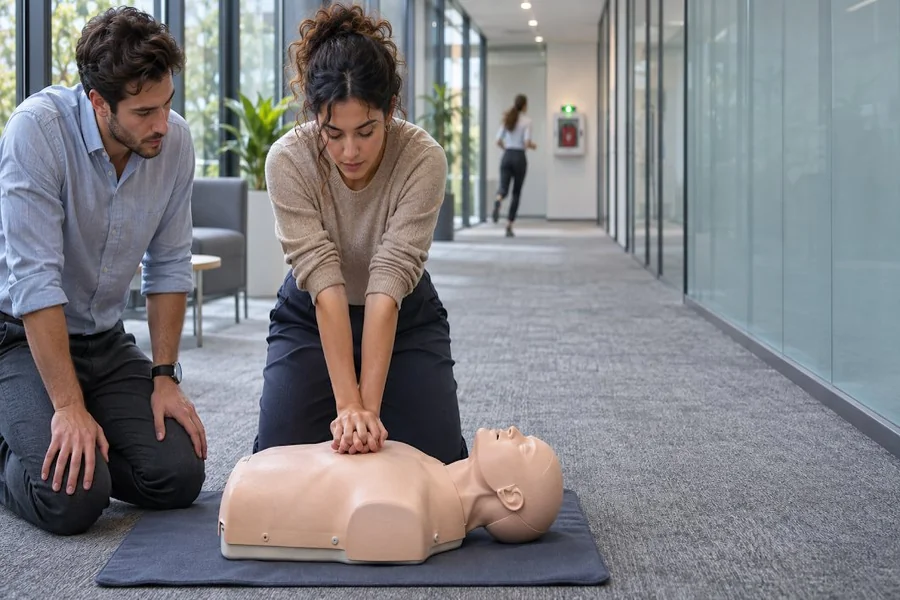
How Many Minutes Do You Really Have? A Time and Distance Guide to CPR and AED Response
How many minutes until help arrives? How far is the nearest AED? Questions like these sound like simple math, but in a cardiac arrest the answers can decide outcomes. This guide turns the numbers into plain language, with metric and imperial units side by side. If you live, work or study in Ottawa, Coast2Coast Ottawa First Aid Training is one way to turn those numbers into skills you can use.
This guide is written for Ontario. Rules and emergency systems in other places differ, so check your own.
How Many Minutes Do You Have?
Not many. Here are the time numbers from Heart & Stroke:
- About 60,000 cardiac arrests happen outside hospitals in Canada each year. That works out to roughly one every nine minutes.
- One in 10 people survives.
- About 10% less chance of survival with every minute that passes without CPR or defibrillation.
- Six minutes or more is a typical emergency response time in urban centres, and it can be longer in remote communities.
- Double the chance. CPR and an AED together can double a person’s chance of survival.
A note on that 10% figure. It’s an average, not an exact curve, and real outcomes vary from person to person. The message is what matters. Every minute counts, and the first minutes belong to whoever is already there.
What Happens in the First Minutes? A Simple Time Chart
Here’s a general guide to the order of actions. It isn’t medical advice, and a hands-on course teaches the details.
| Time | What to do | Why it matters |
| First seconds | Check for a response and for normal breathing | A collapsed person who isn’t responding and isn’t breathing normally needs help now |
| Within about 30 seconds | Call 9-1-1 and shout for an AED | Paramedics are on the way, and someone can fetch the AED |
| Right after the call | Start CPR | Compressions keep blood moving to the brain and organs |
| Until the AED arrives | Keep going | Don’t stop to wait or to check again |
| When the AED arrives | Turn it on and follow its voice instructions | It checks the heart and shocks only if needed |
| Roughly every two minutes | Switch rescuers if someone else can take over | Compressions are tiring, and quality drops with fatigue |
| When paramedics arrive | Hand over and tell them what you did | They take over care |
Heart & Stroke’s three steps match this: call 9-1-1 and shout for an AED, start CPR right away, and use an AED as soon as one is available. Heart & Stroke also stresses that you can’t hurt someone by trying, you can only help.
How Many Compressions Is That?
The numbers add up quickly. The recommended rate for an adult is 100 to 120 compressions per minute, which is about two every second. Here’s the simple arithmetic.
| Time | Compressions at 100 to 120 per minute |
| 1 minute | 100 to 120 |
| 2 minutes | 200 to 240 |
| 6 minutes | 600 to 720 |
That last row is the point. If paramedics take six minutes to arrive, the people on scene could be giving six to seven hundred compressions. That’s why training and pacing matter, and why switching rescuers helps.
Depth matters too. Heart & Stroke’s guidance for an adult is at least 5 cm (about 2 inches) but no more than 6 cm (about 2.4 inches), with full chest recoil between compressions.
How Far Is 500 Feet, and Why Does It Matter for AEDs?
This one is a classic measurement question, and it matters more than it looks. 500 feet is about 152 metres.
Now add walking time. At a normal walking pace of roughly 5 kilometres an hour, 150 metres takes about two minutes. That’s an estimate, and it varies with the person and the route. But the maths is clear. If the nearest AED is 500 feet away, a round trip could take around four minutes at a brisk walk, even before you get past doors, stairs and elevators.
Four minutes is a long time in a cardiac arrest. A few lessons follow:
- Know where the AED is before you need it. Look for one when you enter a new building.
- Send someone straight away. Shouting for an AED while you start CPR saves time.
- Count the obstacles. Stairs, locked doors and long corridors add minutes.
- Plan for large buildings. If you manage a workplace, think about whether one AED can really reach everyone quickly.
What Does Ottawa’s Workplace Rule Add?
If you’re an employer in Ontario, a few more numbers apply. Workplace first aid requirements come from WSIB Regulation 1101. It applies to workplaces with WSIB-covered employers. If you aren’t sure whether your business is covered, the WSIB can confirm. The Ontario Occupational Health and Safety Act (OHSA) also sets general duties for employers to protect workers.
The thresholds depend on how many workers are on a shift:
- 1 to 5 workers per shift: at least one worker with Basic First Aid
- 6 or more workers per shift: at least one worker with Intermediate First Aid
- 200 or more workers per shift: a first aid room with a qualified attendant
Certificates are valid for three years. On June 22, 2026, the WSIB aligned its First Aid Program with the national CSA Z1210:24 standard. Emergency First Aid became Basic First Aid, and Standard First Aid became Intermediate First Aid. The thresholds did not change, and earlier certificates stay valid until they expire. Only providers the WSIB lists can deliver the new certifications.
A note for Ottawa readers. Many workplaces in the city are federally regulated, and those may follow federal rules instead of Ontario’s. Check which rules apply to your workplace before you rely on the numbers above.
How Do You Practise the Numbers?
Reading a chart isn’t the same as doing the skill. Use this routine:
- Take a hands-on course. You want time with mannequins and an AED trainer, plus feedback from an instructor.
- Pick the right level. Match it to your purpose, whether that’s home, school or work.
- Practise the beat. Use a metronome or a song with a beat between 100 and 120 per minute, and count out loud.
- Time yourself. Do a two-minute block, and notice how fatigue changes your pace.
- Find your AEDs. Learn where they are at your workplace, school and gym.
- Refresh before your certificate expires. Put the date in your calendar.
Many providers offer a blended format, with theory online and a shorter in-person session for hands-on skills. To compare formats and dates, check Coast2Coast First Aid class times and ask any provider the same questions.
Why Do Minutes Matter So Much?
Because a few minutes separate a bystander who acts from a bystander who waits. According to Heart & Stroke, nearly half of out-of-hospital cardiac arrests in Canada happen to people under 65. These emergencies aren’t only about older adults.
The numbers aren’t meant to scare anyone. They’re meant to show that quick action, even imperfect action, helps. CPR and an AED can double a person’s chance of survival. You don’t need to wait for certainty. You just need to start.
If you are looking for first aid training near Rideau Street and King Edward Avenue, the Sandy Hill neighbourhood near the University of Ottawa, or surrounding areas in Ottawa, you may reach out to Coast2Coast First Aid & Aquatics in that area.
FAQs
Q: How many minutes does it take for paramedics to arrive?
A: Heart & Stroke notes that emergency response times can be six minutes or more in urban centres, and longer in remote communities. Don’t wait for paramedics before you start CPR.
Q: How many compressions should I give per minute?
A: For an adult, Heart & Stroke’s guidance is 100 to 120 compressions per minute, which is about two per second, at least 5 cm (2 inches) deep and no more than 6 cm (2.4 inches).
Q: Why does the distance to an AED matter?
A: Every minute without CPR or defibrillation lowers the chance of survival by about 10%. If an AED is 500 feet (about 152 metres) away, a round trip on foot could take roughly four minutes. Knowing where AEDs are, and sending someone straight away, saves time.
Q: How long is an Ontario workplace first aid certificate valid?
A: Three years.
Q: How many first aiders does a small workplace need in Ontario?
A: It depends on workers per shift. For one to five, at least one worker should hold Basic First Aid. For six or more, at least one should hold Intermediate First Aid. Confirm how it applies to you with the WSIB, and check whether federal rules apply instead.

Shoaib is a passionate digital creator, blogger, and SEO enthusiast who shares insights about AI tools, blogging, online earning, content strategies, and website growth. Through practical guides and creative ideas, Shoaib helps beginners and creators build successful online platforms and stay updated with the latest digital trends.